

What if the persistent fog or fatigue you feel isn’t a permanent part of your life, but rather a sign that your body’s internal communication lines are experiencing a major traffic jam? It’s incredibly draining to visit specialist after specialist only to be told your results are “normal” while you still battle daily migraines or debilitating vertigo. You deserve to be heard, and you deserve to know that your symptoms aren’t just in your head.
We understand how frustrating it is to feel stuck in a cycle of masking symptoms without ever finding the source of the congestion. By choosing a chiropractic neurological assessment Omaha neighbors can finally gain a clear, objective view of how their nervous system is performing. This precise evaluation acts as a GPS for your health, identifying exactly where the flow between your brain and body has been interrupted.
In this guide, we’ll walk you through the steps of a functional neurological evaluation and show you how a non-invasive diagnostic plan can restore your hope. You’ll learn how identifying the root cause of your discomfort paves the way for natural spinal restoration and a life defined by wellness rather than limitations.
Understanding the Neurological Connection: Why Functional Healthcare in Omaha Starts with the Spine
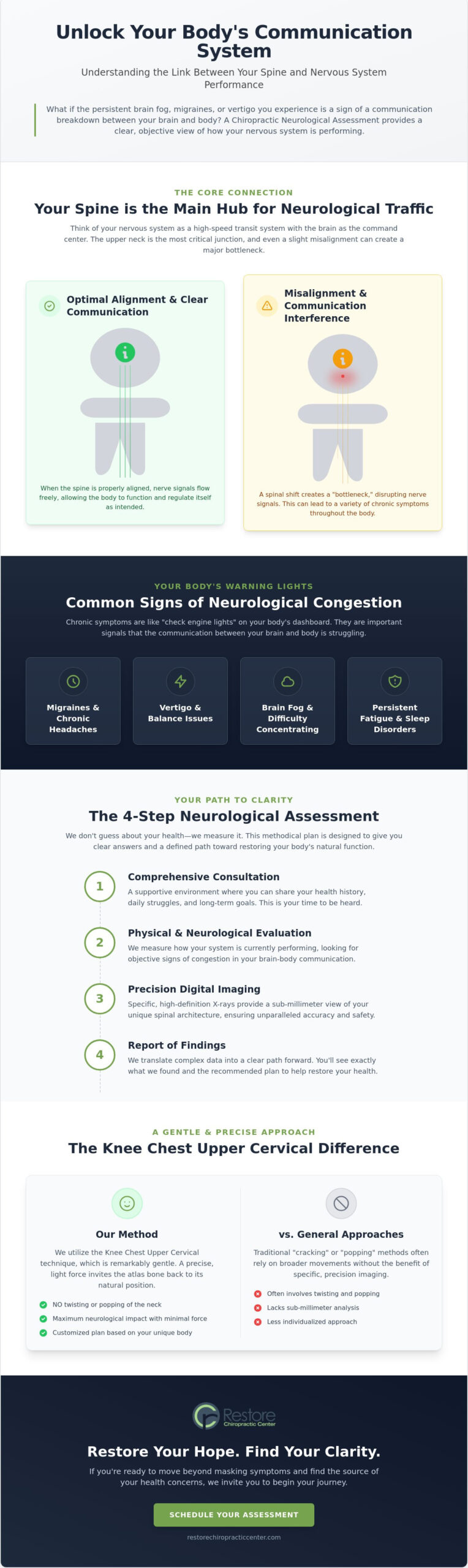
Think of your body as a complex city with a massive transit system. In this metaphor, your brain is the command center, and your nerves are the high-speed rail lines carrying essential data. A chiropractic neurological assessment Omaha patients receive serves as a comprehensive diagnostic tool to measure the efficiency of this system. It establishes a baseline for how well your brain and body are communicating, ensuring that every “train” arrives at its destination on time and without incident.
The upper neck acts as the main hub for all this neurological traffic. When the atlas bone, the very top vertebra of your spine, is even slightly out of alignment, it creates a bottleneck. This congestion disrupts the flow of vital information. Unlike traditional approaches that might only focus on where you feel pain, functional healthcare looks for the reason behind the breakdown. By identifying these interruptions, we can understand why you might be experiencing persistent issues like migraines or vertigo.
The Role of the Central Nervous System
The brainstem is the most critical part of your central nervous system, and it sits right at the level of the upper cervical spine. This area manages your body’s automatic functions, from your heartbeat to your sleep cycles. When you visit a cervical spine chiropractor in Omaha, the focus is on ensuring this master control center remains clear of physical pressure. A thorough neurological examination helps us see if the spine is supporting or hindering your natural physiological performance.
Signs of Neurological Interference
It’s helpful to view chronic symptoms as “check engine lights” on your body’s dashboard. You wouldn’t just put a piece of tape over a warning light in your car, and you shouldn’t ignore the signals your body is sending. Common signs that your neurological flow is congested include:
- Migraines and chronic headaches
- Vertigo or balance issues
- Persistent fatigue and sleep disorders
- Brain fog or difficulty concentrating
These aren’t just isolated problems. They’re often indicators that the communication between your brain and body is struggling. Finding the “why” behind these symptoms is the first step toward lasting wellness and restored hope.
Just as neurological clarity is vital for general health, specialized care such as fertility acupuncture miami can be a transformative resource for those focusing on reproductive wellness and natural conception.
How to Navigate Your Chiropractic Neurological Assessment: A Step-by-Step Guide
Understanding the path to wellness shouldn’t feel like a mystery. When you’re ready to look beyond temporary symptom masking, the process begins with a clear, methodical plan. We don’t guess about your health; we measure it. This journey is designed to transition you from a place of frustration to a state of clarity and renewed hope.
- Step 1: The Comprehensive Consultation. This is your time to be heard. We create a supportive environment where you can share your health history, your daily struggles, and your long-term goals.
- Step 2: The Physical and Neurological Evaluation. This is the core of the chiropractic neurological assessment Omaha residents rely on for answers. We measure how your system is currently performing, looking for signs of congestion in your brain-body communication.
- Step 3: Precision Digital Imaging. We utilize specific X-rays to see the unique architecture of your upper cervical spine. Chiropractic care at this level requires a high-definition view to ensure safety and accuracy.
- Step 4: The Report of Findings. We translate complex data into a clear path forward. You’ll see exactly what we found and how we plan to help you restore your health.
What to Expect During Your First Visit
Your first visit in Omaha is entirely educational and empathetic. We believe in being thorough, which means no adjustments are typically made until all diagnostic data is reviewed. The assessment aims to map the exact degree of spinal misalignment to ensure every subsequent care step is calculated and precise. This patient approach lowers anxiety and builds a foundation of trust.
The Importance of Digital X-Rays
Precision is everything when it comes to the delicate area of the upper neck. Digital imaging allows for sub-millimeter analysis of your spinal alignment. Contrast this with general chiropractic “cracking” which often lacks specific imaging and relies on broader movements. By seeing the exact tilt and rotation of the atlas bone, we can provide a customized plan that respects your body’s unique needs. If you’re ready to start this guided conversation, you can reach out to our team to begin your journey.
From Assessment to Restoration: Your Personalized Path to Wellness
Once the data from your chiropractic neurological assessment Omaha is gathered, it serves as the essential blueprint for your recovery journey. We don’t believe in a one-size-fits-all approach because your neurological “traffic map” is unique to you. If your evaluation reveals specific areas of congestion, your customized care plan is designed to clear those specific blockages. This ensures that every step we take is intentional, moving you away from temporary relief and toward long-term physiological alignment.
The Knee Chest Upper Cervical Difference
We utilize the knee chest upper cervical technique because it’s remarkably gentle. There is no twisting or popping of the neck. Instead, we use a precise, light force to invite the atlas bone back into its natural position. This specific focus allows for maximum neurological impact with minimal physical stress on the body. It’s a methodical way to reset your system and restore the natural flow of information between your brain and your body.
A unique aspect of this care is the “holding” phase. In our practice, the goal isn’t to adjust you at every visit. We want the adjustment to stay in place. When your spine “holds” its alignment, your nervous system can finally begin the work of healing. This is especially encouraging for individuals struggling with chronic conditions like peripheral neuropathy or vertigo. It’s during these periods of stability that the body’s natural restorative powers are most active.
Long-Term Health Goals in Omaha
We invite you to shift your perspective from “fixing a problem” to “maintaining a clear connection.” Your health isn’t a destination you reach and then forget; it’s a continuous journey of renewal. By keeping the communication lines open, you empower your body to perform at its best every day. Many of your neighbors have already found this sense of renewed hope, and you can read about their experiences in our testimonials from Omaha residents. We’re here to be your sanctuary for healing and a trusted partner in your long-term wellness.
Begin Your Journey Toward Restored Health and Clarity
You’ve learned how a clear neurological map can transform your understanding of persistent symptoms. Instead of settling for “normal” results that don’t match how you feel, you can choose a path that prioritizes precision and empathy. It’s about restoring the flow of your body’s internal transit system so you can return to the activities you love without the weight of chronic migraines or vertigo. By identifying the root cause of neurological congestion, you move from a state of distress to a future defined by physiological alignment.
Since 2016, our team has served the Omaha metropolitan area with a specialized focus on the upper cervical spine. Dr. Kyle and Dr. Jenna Johnson are dedicated Knee Chest Upper Cervical practitioners who believe in empowering you with knowledge about your own body. By scheduling a chiropractic neurological assessment Omaha neighbors can finally find a partner who listens and a plan that respects their unique needs. You don’t have to navigate these health hurdles alone; there is always a path back to hope.
Take the first step toward a clearer connection and a more vibrant life today. Schedule Your Comprehensive Neurological Assessment in Omaha Today and discover the difference that specialized, compassionate care can make for your long-term wellness.
Frequently Asked Questions About Functional Healthcare
What is a chiropractic neurological assessment?
A chiropractic neurological assessment Omaha families rely on is a non-invasive evaluation used to measure the communication flow between your brain and body. It involves physical exams and digital imaging to identify where spinal misalignments might be creating neurological congestion. This process helps us understand the “why” behind chronic symptoms by mapping out how your nervous system is currently performing.
Does the neurological assessment involve any pain or invasive procedures?
No, the evaluation is entirely non-invasive and designed to be a comfortable experience. We use gentle physical tests and digital X-rays to map your spinal architecture without any needles or surgical procedures. Our goal is to create a sanctuary for healing where you feel safe and heard throughout the entire process. If we identify a specific issue, we’ll explain the next diagnostic step clearly.
How long does the initial evaluation take in your Omaha office?
You should plan for your initial visit to take approximately 45 to 60 minutes. This dedicated time allows us to perform a thorough consultation, a physical evaluation, and any necessary digital imaging. We move methodically through each step to ensure we capture every detail of your health history. This steady pace helps lower anxiety and ensures that the transition into our care is seamless.
Will I receive an adjustment on my very first visit?
Typically, we don’t provide an adjustment during the first visit. We believe in reviewing all diagnostic data, including your chiropractic neurological assessment Omaha results and digital X-rays, before creating a customized plan. This ensures that every step we take is calculated and precise. By waiting until we have the full picture, we can ensure your path to restoration is based on objective data.
Can a neurological assessment help with migraines and vertigo?
Yes, this assessment is specifically designed to identify the root source of symptoms like migraines and vertigo. By measuring the alignment of the upper cervical spine, we can see if pressure on the brainstem is disrupting your body’s natural balance. If interference is found in your neurological flow, we can then develop a plan for natural restoration. This approach offers hope for those who feel unheard by traditional options.
Is this type of assessment covered by insurance in Nebraska?
Nebraska state law requires insurers to provide reimbursement for services legally performed by licensed healthcare professionals, which includes chiropractic evaluations. Many patients also utilize their Health Savings Accounts (HSA) to cover these costs. For 2026, individual HSA contribution limits have increased to $4,400, providing more flexibility for those seeking natural care. We also provide a “Good Faith Estimate” for those choosing the self-pay option.
Disclaimer
The information in this article is provided for educational purposes only and is not intended to diagnose, treat, cure, or prevent any condition. It should not replace professional medical advice. Always seek the guidance of a qualified healthcare provider with any questions regarding your health.


