

Could two small bones at the top of your neck explain headaches or dizziness? The atlas and axis support your head and help it move, but their anatomy alone can’t identify the cause of symptoms. If the names C1 and C2 are unfamiliar, understanding their different roles can make upper-neck anatomy easier to follow.
This article explains where the atlas and axis sit, how the atlas supports the skull, and how the axis helps your head rotate. It also explains how these bones relate to nearby nervous system structures, and why that closeness doesn’t prove they are responsible for migraines, vertigo, or other symptoms. The goal is to clarify what C1 and C2 do, and what anatomy alone can’t tell you.
Atlas and Axis Anatomy: Where C1 and C2 Sit in the Neck
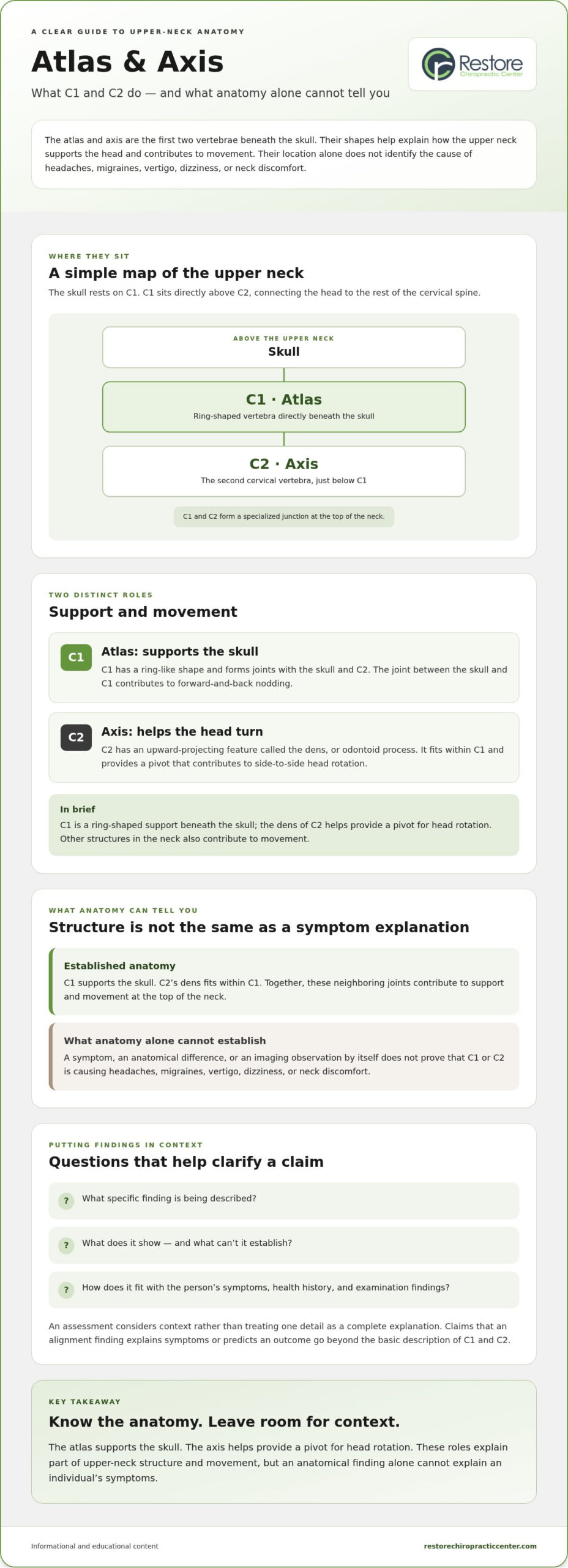
In standard anatomical terminology, the atlas is the first cervical vertebra, C1, and the axis is the second, C2. They sit at the top of the neck, directly beneath the skull. C1 is closest to the head, with C2 just below it. The Atlas (C1) vertebra supports the skull and forms joints with both the skull and C2, connecting the head to the rest of the cervical spine.
For a simple location guide, picture the vertebrae as a short stack: the skull rests on C1, and C1 sits on C2. The atlas has a ring-like shape rather than the typical solid vertebral body. C2 has an upward-projecting bony feature called the dens, or odontoid process, which fits within the ring of C1. Together, the atlas and axis form a specialized junction that supports head movement.
Why C1 Is Called the Atlas and C2 the Axis
The name “atlas” is commonly linked to the figure from Greek mythology who carried the heavens, a fitting image for the vertebra beneath the skull. “Axis” reflects C2’s pivot-like role in the upper neck. These names describe anatomy and function, not a clinical problem. In particular, the word “alignment” alone doesn’t establish that either vertebra is causing headaches, vertigo, or other symptoms.
Knowing where C1 and C2 sit provides a useful map of the upper neck. It explains how the skull connects to the spine, but anatomy by itself can’t determine the source of an individual’s symptoms.
How the Atlas and Axis Work Together to Support Neck Movement
The atlas and axis have different shapes and work as neighboring joints, rather than as a single hinge. The joint between the skull and C1 contributes to the head’s forward-and-back nodding motion. The joint between C1 and C2 contributes to turning the head from side to side. Other structures in the neck also contribute to these movements, so neither joint moves the head without limits.
Visible Body’s overview of the atlanto-axial relationship describes how these joints support distinct motions.
Quick comparison
- C1, the atlas: Its ring-shaped structure supports the skull and connects with it at the joint associated with nodding.
- C2, the axis: Its upward projection, the odontoid process or dens, fits within C1 and serves as a pivot for some head rotation.
What Makes C1 and C2 Different from Other Neck Vertebrae?
Unlike the more typical vertebrae below them, C1 lacks a vertebral body and forms a ring around the dens. C2 has the dens projecting upward from its body. Their distinct shapes and connections create a specialized link between the skull and the rest of the neck.
In short, C1 is a ring-shaped support beneath the skull, while C2’s dens provides a pivot that helps the head turn.
Anatomy varies, and an imaging observation by itself doesn’t show whether a particular feature is causing headaches, neck discomfort, or dizziness. Symptoms and imaging findings need to be considered in context. If you’d like to learn about a local consultation, see what a first visit involves.
What Atlas and Axis Anatomy Can, and Cannot, Tell You About Symptoms
Knowing where C1 and C2 sit helps explain the structure of the upper neck, but it can’t by itself explain why someone has headaches, vertigo, or neck discomfort. Symptoms alone don’t establish that the atlas or axis is the cause. Likewise, an anatomical difference or imaging observation doesn’t automatically show that it is related to what a person is experiencing.
Understanding symptoms requires context. An individual assessment may consider health history and examination findings together, rather than treating one detail as a complete explanation. When discussing an imaging observation or a claim about alignment, useful questions include: What specific finding is being described? What does it show, and what can’t it establish? How does it fit with the person’s symptoms and examination? This helps distinguish established anatomy from conclusions that require more evidence.
How to Read Claims About Atlas Alignment and Health
It’s established anatomy that the atlas and axis have specialized shapes and contribute to support and movement at the top of the neck. Claims that an alignment finding explains migraines, predicts a particular outcome, or accounts for symptoms elsewhere in the body go beyond that basic description. A finding may be worth discussing, but it doesn’t prove cause and effect on its own.
For general information about upper cervical chiropractic, Restore Chiropractic Center serves the Omaha area, including Omaha, Ralston, La Vista, Bellevue, and Papillion. Its practitioners provide knee chest upper cervical chiropractic care. Learning about the approach can offer context, but it isn’t a substitute for an individualized evaluation or other professional medical care.
The clinic’s first-visit information explains what to expect from a consultation. Restore Chiropractic Center offers neurological and physical assessments and digital x-rays as part of its diagnostic services. You can use a consultation to discuss questions with a practitioner, without assuming that any particular finding will explain or resolve symptoms.
Build a Clearer Picture of Your Upper Neck
The atlas and axis are neighboring vertebrae with distinct roles: C1 supports the skull, while C2 helps provide a pivot for head rotation. Together, they contribute to movement at the top of the neck, but an anatomical finding alone can’t explain headaches, vertigo, or neck discomfort. Symptoms call for context, not assumptions based on one structure or image.
If you’re in the Omaha metropolitan area and want to learn about upper cervical chiropractic, Restore Chiropractic Center offers consultations and neurological and physical assessments. These give you an opportunity to discuss questions with a practitioner without presuming what may be behind your symptoms.
Learn more about upper cervical chiropractic care at Restore Chiropractic Center, serving Omaha, Ralston, La Vista, Boys Town, Bellevue, Papillion, St. Columbans, Carter Lake, Council Bluffs, and Offutt Air Force Base.
Frequently Asked Questions
What are the atlas and axis in the spine?
The atlas and axis are the first two vertebrae in the neck, known as C1 and C2. They sit just beneath the skull, at the top of the cervical spine. C1 supports the skull and connects with C2, forming part of the link between the head and the rest of the neck.
How are the atlas and axis different?
The atlas, or C1, has a ring-like shape and supports the skull. The axis, or C2, has an upward-projecting feature called the dens, which fits within the ring of C1. Their different shapes allow them to form specialized joints that contribute to head support and movement.
Do the atlas and axis help your head turn?
Yes. The joint between C1 and C2 contributes to side-to-side head rotation, while the joint between the skull and C1 contributes to nodding. Other structures in the neck also contribute to these movements, so turning your head isn’t unrestricted motion at a single joint.
Can atlas or axis alignment explain headaches or vertigo?
Headaches or vertigo alone can’t show that C1 or C2 alignment is responsible. Symptoms need to be understood in individual context, and an imaging observation alone doesn’t prove a cause. Restore Chiropractic Center serves Omaha, Ralston, La Vista, Boys Town, Bellevue, Papillion, St. Columbans, Carter Lake, Council Bluffs, and Offutt Air Force Base, offering consultations and neurological and physical assessments.
Disclaimer
The information in this article is provided for educational purposes only and is not intended to diagnose, treat, cure, or prevent any condition. It should not replace professional medical advice. Always seek the guidance of a qualified healthcare provider with any questions regarding your health.


