

What if the most effective way to address your chronic migraines isn’t through forceful twisting, but through a gentle, mathematical precision that respects your body’s delicate architecture? Many people in Omaha feel caught in a cycle of temporary relief, tired of generic care that only masks the underlying issues of vertigo or persistent headaches. It’s natural to feel hesitant about chiropractic care if you’re afraid of the “cracking” sounds often associated with traditional methods. When you’re looking for a more refined approach, understanding the differences between knee chest vs nucca is the first step toward finding a path that feels safe and effective for your unique needs.
We understand the frustration of feeling like your nervous system is congested, preventing you from living your life with full vitality. This article will clarify how these two specialized upper cervical methods compare, focusing on how they restore the vital flow between your brain and body. By the end, you’ll have a clear vision of how a customized care plan can help you move from a state of physical struggle to a future of renewed wellness. We’re here to help you navigate these choices with confidence, ensuring you find the sanctuary for healing you deserve.
Understanding Upper Cervical Care: The Foundation of Health Restoration
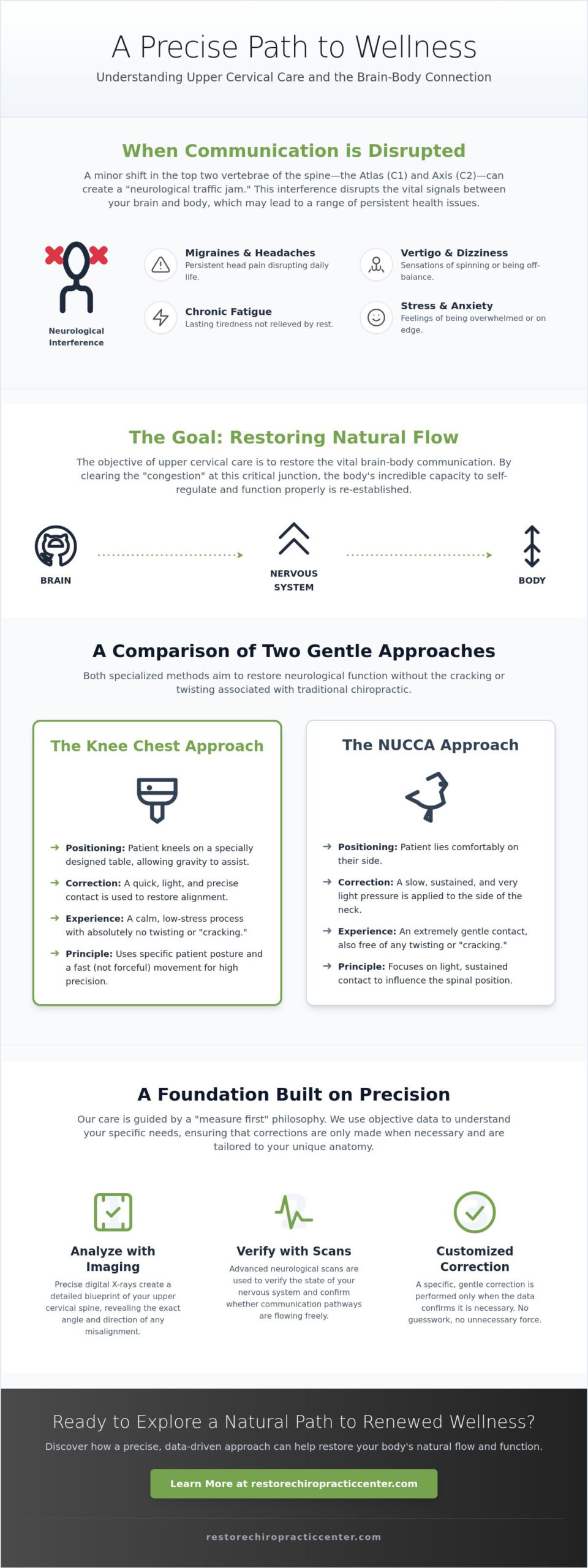
Upper cervical care is a specialized field that focuses specifically on the top two vertebrae in your spine, known as the Atlas (C1) and the Axis (C2). These two small bones carry a massive responsibility. They protect the brainstem and serve as the primary gateway for all neurological traffic traveling between your brain and your body. Think of this area as a vital transit hub. If the lanes are clear, signals move swiftly and accurately. However, if a misalignment occurs, it creates a form of internal congestion that disrupts the natural flow of information.
This neurological traffic jam can lead to a variety of systemic issues. When the signal flow is compromised at this critical junction, people often experience debilitating migraine headaches or the disorienting sensations of vertigo. As you research knee chest vs nucca, you’ll find that both methods aim to clear this congestion, though they use different mechanical approaches to reach that goal. Both paths seek to restore the vital communication required for your body to function at its peak.
The Importance of the Brain-Body Connection
The brainstem acts as the “command center” for your autonomic nervous system, regulating everything from your heartbeat to your digestion without you ever having to think about it. When this connection is clear and the transit lines are open, your body possesses an incredible ability to self-regulate and heal naturally. At Restore Chiropractic Center, we focus on maintaining this neurological integrity to support overall wellness, including providing a natural path for stress and anxiety relief.
Why Focus Only on the Upper Neck?
The anatomy of the Atlas bone is unlike any other vertebrae in the spine because it has no interlocking discs to hold it in place. Instead, it relies entirely on a complex web of ligaments for stability, making it both highly mobile and susceptible to shifting out of alignment. Even a minor shift, measured in millimeters, can create systemic neurological interference. While some practitioners utilize the NUCCA technique to address these shifts through light pressure, the Knee Chest approach uses specific patient positioning to restore alignment. This focus on the upper neck ensures that the foundation of your health is secure, allowing the rest of your body to function as intended.
Knee Chest vs NUCCA: Comparing the Two Specialized Approaches
While both methods share the goal of clearing neurological congestion, the physical experience of knee chest vs nucca differs significantly. In the NUCCA approach, a patient typically lies on their side while a practitioner applies a slow, sustained pressure to the side of the neck. In contrast, the Knee Chest method utilizes a specific kneeling posture. This positioning isn’t just about comfort; it’s a strategic alignment that allows the practitioner to work with the body’s natural geometry to restore flow. By using this posture, we can access the upper neck with incredible precision, ensuring the nervous system can communicate without interference.
A common point of confusion involves the mechanism of the correction itself. The Knee Chest approach uses a precise, manual “drop” to facilitate the adjustment. While some technical descriptions might use terms like “high force,” this actually refers to the speed of the movement, not the intensity felt by the patient. It’s a quick, light contact designed to move the Atlas bone back into its proper place without the need for sustained pressure. Both approaches are rooted in the foundational principles of chiropractic care, emphasizing the body’s innate ability to heal when the brain-body connection is restored.
The Knee Chest Experience: Precision and Comfort
Walking into a Knee Chest office, you’ll notice a specialized table designed to support your body in a very specific way. This kneeling posture allows gravity to assist in the correction, making the process feel natural and low-stress. Because the table provides a stable foundation, the practitioner can be incredibly precise with minimal effort. Most importantly for those who are fearful of traditional methods, there is absolutely no twisting or “cracking” of the neck. If you’ve been searching for a no crack chiropractor in Omaha who can deliver gentle, precise spinal care without the intimidating sounds of traditional adjustments, this approach may be exactly what you’re looking for. It’s a sanctuary of calm where the focus is entirely on opening the lines of communication within your body.
Analysis and Imaging: Measuring the Misalignment
Success in upper cervical care depends on the quality of the initial data. We use digital x-rays to map the unique architecture of your spine before any adjustment is made. This “measure first” philosophy ensures that we never apply unnecessary force. By combining these images with specific neurological scans, we can verify that the neurological traffic is moving freely again. This data-driven approach is what makes these techniques different from general chiropractic. If you’re ready to see how this precision can help you find relief from migraines or fatigue, you can explore our approach to natural care to see if it’s the right fit for your journey.
Choosing the Best Path for Your Health in Omaha
Choosing a specialized path for your health is an empowering decision. Whether you’re searching for a “nucca chiropractor near me” or looking specifically for the Knee Chest approach, you’re already moving toward a higher standard of care. Both of these methods are exceptional choices for individuals who want to avoid the forceful cracking or twisting of traditional methods. When comparing knee chest vs nucca, it’s helpful to remember that the “best” technique is ultimately the one that allows your body to hold its alignment for the longest period. Stability is the primary goal of our work.
At Restore Chiropractic Center, Dr. Kyle and Dr. Jenna specialize in the Knee Chest technique. We’ve seen how this specific positioning helps patients in our community find a path toward lasting wellness. While organizations like the National Upper Cervical Chiropractic Association (NUCCA) provide valuable research on the importance of the upper neck, our focus remains on the unique mechanical advantages that Knee Chest offers. We invite you to experience a first-visit consultation to see if this approach aligns with your specific health needs.
Personalized Care Plans in the Omaha Community
Our practice serves as a neighborly fixture for families in Ralston, Elkhorn, and the greater Omaha area. We don’t believe in a one-size-fits-all model because every nervous system is unique. Instead, your care is tailored specifically to your neurological state. Our mission is to guide you from a state of internal congestion to a state of full restoration. We want to ensure your brain and body can communicate without any hidden roadblocks.
What to Expect During Your Initial Consultation
Your journey begins with a series of non-invasive neurological and physical assessments. We’ve designed our clinic to be a sanctuary, a calm space where your anxiety can melt away. If you’re curious about how this has changed lives for others in Nebraska, we encourage you to read through our patient testimonials. You’ll find success stories from neighbors who once struggled with migraines and vertigo but found a new vision for their future through precise, gentle care.
Your Path to Lasting Neurological Flow
Since 2016, Dr. Kyle and Dr. Jenna Johnson have served the Omaha, Ralston, and Elkhorn communities as a trusted sanctuary for healing. By using advanced digital imaging and neurological scans, we ensure that every adjustment is guided by data and tailored to your specific needs. It’s time to stop managing symptoms and start focusing on restoration. You don’t have to navigate this journey alone. We invite you to schedule your personalized upper cervical consultation in Omaha today. Your future of renewed wellness and steady flow is waiting.
Frequently Asked Questions
Is the Knee Chest adjustment painful or scary?
The Knee Chest adjustment is designed to be gentle and is not painful for the vast majority of patients. Because we use specific positioning and precise digital mapping, the correction is delivered with a light touch that feels more like a quick tap than a forceful push. There is absolutely no twisting, popping, or cracking of the neck involved. This approach is specifically designed to lower anxiety for those who are wary of traditional chiropractic methods.
How do I know if I need a specialized upper cervical chiropractor instead of a general one?
You may need a specialized upper cervical chiropractor if you’re experiencing symptoms that suggest a neurological traffic jam, such as migraines, vertigo, or chronic fatigue. While general chiropractic addresses the entire spine, we focus specifically on the gateway between the brain and the body. When comparing knee chest vs nucca, you’ll find that both specialized fields prioritize precision and neurological flow over simple joint mobility. If your symptoms persist despite general care, a closer look at the Atlas and Axis vertebrae is often the missing step.
Can Knee Chest care help with conditions like fibromyalgia or peripheral neuropathy?
How many visits will I need before I start feeling a difference in my health?
The number of visits required varies based on your unique neurological state and how long the misalignment has been present. Many patients begin to notice a shift in their vitality within the first few weeks as their body learns to hold the correction. General research indicates that 70-85% of patients report significant improvement in their primary symptoms within 4-8 weeks of starting specialized care. Our goal is to move you toward a state of stability where you need fewer adjustments over time, allowing your body to maintain its own health naturally.
Disclaimer
The information in this article is provided for educational purposes only and is not intended to diagnose, treat, cure, or prevent any condition. It should not replace professional medical advice. Always seek the guidance of a qualified healthcare provider with any questions regarding your health.


